Conflict Minerals


Introduction
Initially addressed in the 2010 Section 1502 of the United States Dodd-Frank Act with a specific focus on DRC and its surrounding countries, conflict minerals have been subsequently defined by the EU Conflict Minerals Regulation as conflict minerals originating from Conflict-affected and high-risk areas (CAHRAs). According to Regulation (EU) 2017/821, Conflict Affected and High-Risk Areas means ‘areas in a state of armed conflict or fragile post-conflict as well as areas witnessing weak or non-existent governance and security, such as failed states, and widespread and systematic violations of international law, including human rights abuses’ and refers to regions particularly in the African Great Lakes Region, but not exclusively.
4 minerals are currently considered “conflict minerals” by both US and EU and are currently referred to as the 3TG[1]:
Tantalum
Tin
Tungsten
Gold
The mining and commerce of 3TG generates conflicts, regional instability, and human rights abuses (such as perilous working conditions, child labor, and food insecurity). These are perpetuated by violent armed groups who exploit profits from the conflict minerals trade to purchase weapons, pay combatants, and commit international law violations in high-risk areas across the globe.
With the goal to cut direct and indirect funding of armed groups engaged in conflict and human rights abuses policies, processes and legal acts were developed.
ArcelorMittal is subject to major bodies of regulation that address conflict minerals reporting:
US Dodd Frank Act & United States Securities and Exchange Commission (SEC)
The legislation requires companies that report to the US Securities Exchange Commission (SEC) to disclose if any of the minerals used in their products have been sourced from the Democratic Republic of Congo or any of the adjoining countries, and to describe how they have verified this. The SEC final rule embodies a three-step approach to Dodd-Frank compliance:
Determining applicability of the rule
Conducting a “reasonable country of origin inquiry” (RCOI) to determine whether or not there is reason to believe that conflict minerals from DRC or an adjoining country are present in a company’s product.
An adjoining country is defined as a country that shares an internationally recognized border with the Democratic Republic of Congo: Angola, Burundi, Central Africa Republic, Republic of Congo, Rwanda, Tanzania, Uganda, Zambia. The adjoining countries plus the DRC are altogether called “Covered Countries” in the Dodd-Frank Act.
Conducting due diligence to determine the source and origin of those conflict minerals and the facilities smelters or refiners (SORs) in which they were processed.
European Conflict Minerals Regulations
To fulfill the due diligence requirements a company must use a nationally or internationally recognized standard such as the OECD Guidance in order to meet their compliance and reporting obligations. ArcelorMittal is using the OECD Due Diligence Guidance for Responsible Supply Chains of Minerals from Conflict-Affected and High-Risk Areas (OECD Guidance) for the RCOI and, when applicable, the due diligence in order to meet its compliance and reporting obligations.
The EU defines CAHRAs as:
Regions in a state of armed conflict
Areas suffering conflict aftermath
Regions made fragile by weak governance or lack of governance, such as failed states, regions, or countries known to systematically violate international law
ArcelorMittal has implemented the OECD Due Diligence Guidance for Responsible Supply Chains of Minerals from Conflict-Affected and High-Risk Areas (OECD Guidance).
The OECD Guidance is a collaborative initiative by governments, international organizations, industry leaders and civil society with the aim to help companies prevent human rights violations, labor & environmental abuses and avoid contributions to conflict.
In accordance with the OECD Guidance process, ArcelorMittal has adopted and implemented the 5 steps outlined below (2):
i. OECD Guidance Step 1: Establish strong company management systems
ii. OECD Guidance Step 2: Identify and assess risks in the supply chain
iii. OECD Guidance Step 3: Design and implement a strategy to respond to identified risks
iv. OECD Guidance Step 4: Conduct independent third-party audit of supply chain due diligence at identified points in the supply chain
v. OECD Guidance Step 5: Report annually on supply chain due diligence.
1. OECD Guidance Step 1: Establish strong company management systems
The objective of ArcelorMittal Conflict minerals process is to ensure that existing due diligence and management systems within ArcelorMittal address risks associated with minerals from conflict.
Adopting and publicly communicating its policy regarding its handling of Conflict Minerals
ArcelorMittal has included in its Responsible Sourcing Policy and Code its commitment to use only raw materials in ArcelorMittal products, whose extraction, production, transport, trade, processing, and export neither directly nor indirectly contribute to human rights abuses, health & safety issues, environmental pollution, or compliance breaches, not associated with crime and armed conflict. Additionally, regarding conflict minerals, from conflict-affected and high-risk areas, ArcelorMittal has stated that due diligence processes are in accordance with the OECD Due Diligence Guidance for Responsible Value Chains of Minerals from Conflict-Affected and High-Risk Areas. ArcelorMittal expects its concerned suppliers to meet the requirements described in its Conflict Minerals Procedure.
Establishing governance & resources
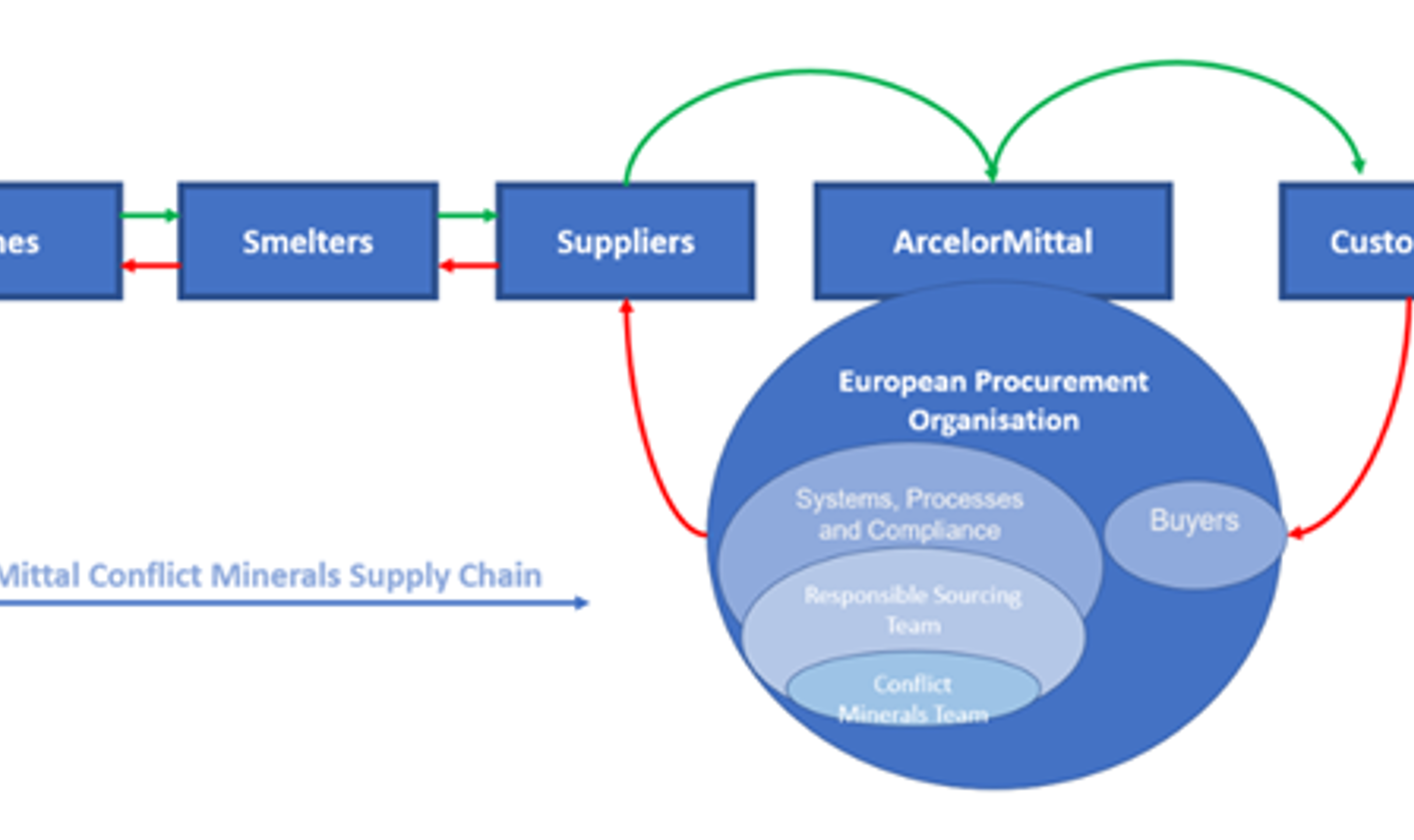
The ArcelorMittal Responsible Sourcing Team is part of the European Procurement Organisation (EPO) and is responsible of conflict minerals related topics, ensuring application of requirements. The responsible sourcing team supports and monitors the Conflict minerals process.
Supported by Senior Executive Officers, the team acts as internal experts on this topic, performing due diligence, conducting risk assessments compiling conflict minerals reports, and training suppliers and ArcelorMittal employees when required.
System of Controls and transparency
The Conflict Minerals Reporting Template (CMRT) issued by Electronic Industry Citizenship Coalition and Global e-Sustainability Initiative (EICC and GeSI) has been selected by ArcelorMittal to facilitate the transfer of information throughout its supply chain and provide control and transparency over the conflict minerals country of origin and the smelters or refiners involved.
The CMRTs serve as means of communication both between ArcelorMittal and its suppliers and ArcelorMittal and its customers.
Each year, ArcelorMittal investigates its tin and tungsten (as only those minerals are used in the company’s products) suppliers using the CMRT: CMRTs are completed by the investigated suppliers, sent to the responsible sourcing team, and permanently stored on the central Vendor management database.
ArcelorMittal’s grievance mechanism enables all stakeholders to voice concerns on topics including conflict minerals.
Engagement with concerned suppliers
ArcelorMittal enforces its commitment to support and implement its conflict minerals program through its Responsible Sourcing Policy and Code: “regarding conflict minerals, from conflict-affected and high-risk areas, the Company has established due diligence processes in accordance with the ‘OECD Due Diligence Guidance for Responsible Chains of Minerals from Conflict-Affected and High-Risk Areas’. ArcelorMittal expects its concerned suppliers to meet the requirements described in its Conflict Minerals Procedure. Doing so, suppliers will have to map their supply chain and share sourcing information regarding the origin of the material sold to ArcelorMittal.”
The Code is sent to the relevant suppliers with a request to acknowledge they have received and read it An annual survey is conducted where suppliers are expected to complete the CMRT and send us their Conflict Minerals Policy.
When necessary, explanatory conference calls with suppliers are organized to reinforce principles and requirements related to conflict minerals handling/processing.
2. OECD Guidance Step 2: Identify and assess risk in the supply chain
Identification of suppliers by identifying the relevant steel products
ArcelorMittal offers a vast spectrum of steel products: meticulously reviewing those products, our team of experts concluded that only tin and tungsten were part of a very limited number of steel products sold by the company. In addition, ArcelorMittal’s packaging business produces tinplate for a global market. Very few steel grades for electrical applications can also contain intentionally added tin. Tungsten is used to provide extreme hardness to some steel products (tool steel plate and some quarto plates).
In addition to the products that are sold to customers, some products for self-consumption and / or steel production can contain mainly tungsten (e.g. rolls and tool steel plates).
Most raw materials are purchased centrally by EPO: buyers of tin and tungsten are in the position to identify the relevant suppliers. For raw material not purchased centrally, buying teams have been made aware of the requirement and are thoroughly implementing the rules required for the proper implementation of our due diligence with co-ordination and support of the EPO Responsible sourcing team.
Request information from identified suppliers
ArcelorMittal uses the RMI’s CMRT to obtain the names of the smelters or refiners (SORs) from the identified suppliers on an annual basis.
Review information provided by identified suppliers
The Responsible Sourcing team reviews the information provided in the CMRT checking completeness and ensuring that the data provided correlates with internal data. As part of that process, suppliers’ conflict minerals policies are checked if available.
Before becoming an ArcelorMittal vendor, any new contender will be asked to supply a CMRT. Incomplete or unsatisfactory documents or reluctance to provide the requested data will lead to the contender’s disqualification.
Compare SORs identified in the supply chain to assess possible risks
The responsible sourcing team compares the names of the SORs listed in the CMRTs against the Conflict-Free Smelter Initiative (CFSI) Conflict-Free Smelter Program list.
Suppliers are required to only source from smelters or refiners confirmed to be “conformant” by the CFSI.
If this is not the case, the responsible sourcing team investigates further to ensure the SORs used are sourcing from legitimate sources, e.g. legitimate mines. The following documents will be required and verified:
Conflict Minerals Policies for Smelters
An official declaration from both smelters confirming the country of origin of the material, quantities imported and when they were mined
Verification that the SORs are not part of the CAHRA(s) list
Certificate of origin
Mining License
Local Taxes Certificate
Business License
Transportation document for the products shipped to ArcelorMittal
list minerals they're importing by trade name and type
When minerals come from conflict-affected and high-risk areas (CAHRA), the information below will be obtained:
the mine the minerals originated from;
where the minerals were consolidated, traded and processed, and;
the taxes, fees and royalties paid.
3. OECD Guidance Step 3: Design and implement a strategy to respond to identified risks
Red Flags
The following red flags trigger further due diligence to be conducted by ArcelorMittal:
Unidentified smelters
The minerals originate from or have been transported via a conflict-affected or high-risk area (as per CAHRAs list).
The minerals are claimed to originate from a country that has limited known reserves, likely resources or expected production levels of the mineral in question.
The minerals are claimed to originate from a country in which minerals from conflict-affected and high-risk areas are known to transit.
The company’s suppliers or other known upstream companies have shareholders or other interests in companies that supply minerals from or operate in red flagged locations of mineral origin and transit.
The company’s suppliers or other known upstream companies are known to have sourced minerals from a red flag location of mineral origin or transit in the last 12 months.
Enhanced Due Diligence
ArcelorMittal’s enhanced due diligence is conducted based on the following information:
Independent assessment or validation schemes (preferably CFSI)
Statements or other assertions of SORs
Indirect information (such a smelter location, metal association reports, independent reports, UN reports etc.)
Where ArcelorMittal is not directly in contact with SORs the responsible sourcing team is performing a documentation-based review only.
Risk Management Plan
If SORs cannot be identified or if any supplementary red flag is triggered, ArcelorMittal will require relevant suppliers to encourage or require the SORs they source directly from to participate in a 3rd Party audit.
Results of the audit will be required by ArcelorMittal. Findings and corresponding actions are communicated to management as part of the risk management process.
4. OECD Guidance Step 4: Conduct independent third-party audits of supply chain due diligence at identified points in the supply chain
ArcelorMittal will make available substantive evidence, including third-party audit reports, demonstrating that all smelters and refiners in the supply chain comply with the regulations. As such, ArcelorMittal relies on the list of conformant smelters and refiners made available by the CFSI instructing their suppliers only to source from those conformant smelters. ArcelorMittal currently relies on the list of conformant smelters and refiners made available by the RMI and will also refer to the list of global responsible smelters and refiners from the European Commission once this is published.
5. OECD Guidance Step 5: Report on supply chain due diligence.
ArcelorMittal annually discloses the results of its conflict minerals supply chain due diligence on its corporate web page. In this disclosure, ArcelorMittal reports the results of its Reasonable Country of Origin Inquiry data.
On a yearly basis, a SD form sharing supply chain due diligence practices and results is filed to the SEC (SEC form SD). Supply chain due diligence practices and results will be shared with EU member states when requested.
Internal records of due diligence findings, investigations are maintained for 5 years. Internal records of due diligence findings, investigations, are maintained for 5 years.
Appendix
Conflict Minerals Reporting Template (the latest version can be found on: Conflict Minerals Reporting Template (responsiblemineralsinitiative.org))
Results of the Conflict Minerals Survey on Tin and Tungsten Smelters
The conflict Minerals Survey was finalized in May 2026. It covers tin and tungsten purchases from January 1st 2025 to December 31st, 2025.
Results of the 2025 Conflict Minerals Survey (May 2026)
Product | Smelter Facility Location Country | Number of Smelters | Suppliers Response Rate |
|---|---|---|---|
Results for year 2025 | |||
Tin | Peru, Belgium, Brazil, China | 4 | 100% |
Tungsten | Vietnam, China | 3 | 100% |
Results for year 2024 | |||
Tin | Belgium, Bolivia, Brazil, China, Peru | 7 | 100% Response rate |
Tungsten | China, Vietnam | 2 | 100% Response rate |
Results for year 2023 | |||
Tin | China, Brazil, Belgium, Poland, Indonesia, Peru | 17 | 100% Response rate |
Tungsten | China, Vietnam, Brazil | 4 | 100% Response rate |
Results for year 2022 | |||
Tin | Bolivia, Peru, China, Spain, Indonesia, Brazil, Belgium (recycler) | 15 | 100% Response rate |
Tungsten | China, Russian Federation, Republic of Korea | 3 | 100% Response rate |
Results for year 2021 | |||
Tin | Bolivia, Hong Kong, Thailand, China, Spain, Malaysia, Indonesia, Brazil, Belgium (recycler) | 13 | 100% Response rate |
Tungsten | China, Russian Federation, Republic of Korea | 8 | 100% Response rate |
Results for year 2020 | |||
Tin | Belgium (recycler), Bolivia, Brazil, China, Indonesia, Malaysia, Peru, Thailand | 13 | 100% Response rate |
Tungsten | China, Russian Federation, Vietnam | 4 | 100% Response rate |
Results for year 2019 | |||
Tin | Belgium (recycler), Bolivia, Brazil, China, Indonesia, Malaysia, Peru, Russian Republic, Thailand, Poland, Hong Kong | 23 | 100% Response rate |
Tungsten | Vietnam, Republic of Korea, Russian Federation, China | 9 | 100% Response rate |
Results for year 2018 | |||
Tin | Belgium (recycler), Bolivia, Brazil, China, Indonesia, Malaysia, Peru, Poland, Thailand | 29 | 100% Response rate |
Tungsten | China, Russian Federation, Vietnam | 4 | 100% Response rate |
Results for year 2017 | |||
Tin | Belgium (recycler), Bolivia, Brazil, China, Indonesia, Malaysia | 23 | 100% Response rate |
Tungsten | Brazil, China, Russian Federation, Vietnam | 6 | 100% Response rate |
Results for year 2016 | |||
Tin | Belgium (recycler), Bolivia, Brazil, China, Indonesia, Malaysia, Peru, Poland, Poland, Taiwan, Thailand | 29 | 100% Response rate |
Tungsten | China, Russian Federation, Vietnam | 5 | 100% Response rate |
Results for year 2015 | |||
Tin | Bolivia, Belgium (recycler), Brazil, China, Indonesia, Peru, Poland, Russian Federation, Taiwan | 15 | 100% Response rate |
Tungsten | China, Russian Federation, Vietnam | 7 | 100% Response rate |
Full text available at: http://www.gpo.gov/fdsys/pkg/STATUTE-124/pdf/STATUTE-124-Pg1376.pdf
Full text available at: http://www.sec.gov/rules/final/2012/34-67716.pdf
Full text available at: http://www.oecd.org/daf/inv/mne/GuidanceEdition2.pdf
[1] Any other minerals deemed by recognized governmental authorities as conflict minerals will be instantly considered and handled through ArcelorMittal Conflict Minerals process.